
A product philosophy for preserving how understanding develops
In 1515, an Indian rhinoceros arrived in Lisbon, the first living rhinoceros seen in Europe in more than a thousand years. News of the animal travelled north in a merchant’s letter, accompanied by a sketch whose authorship remains uncertain. By the time the account reached Albrecht Dürer in Nuremberg, the animal itself was hundreds of miles away.
Dürer never saw it.
What he made from that indirect evidence was a woodcut so visually convincing that it became Europe’s standard image of a rhinoceros for centuries. It was also wrong. The body appeared covered in armour-like plates. A small horn emerged from its back. The legs were patterned with scales.
It was not a fraud. Dürer worked in good faith from the evidence available to him, and the errors do not diminish the achievement; the woodcut is a superb piece of work. That is exactly what makes it useful as an emblem. Nothing went wrong in the maker’s honesty or in his skill. What went wrong was the relationship between representation, evidence, skill and authority.
High skill can make weak or incomplete evidence persuasive. Repetition can then let the resulting representation outlive the evidence behind it. And longevity gets mistaken for corroboration: an image that has been around for two centuries starts to feel confirmed by the fact of its own survival.
The chain existed, but it was lossy: animal, witness, sketch, description, transmission, interpretation, woodcut, reproduction. What weakened along the way was contact with the thing represented. The image survived better than the conditions under which it had been made.
And the copies multiplied. They added reach; they added no independent evidence. This is the failure mode that a networked world has industrialised: frequency mistaken for independence. A claim appears to have hundreds of sources, and tracing the links reveals that all of them descend from one report. Five accounts derived from one witness are not five witnesses. Independence is not even binary: sources can share methods, assumptions, institutions, incentives or upstream material, and the degree of it is the thing that has to be examined rather than assumed.
Dürer’s rhinoceros survived because it was compelling, reproducible and available. Its evidence did not become stronger as its authority grew.

Michelangelo’s David presents the inverse problem.
The statue can look like a standalone act of genius: a colossal figure completed from a damaged block in under three years by a young sculptor. That compressed story hides two histories.
The block first. It had been quarried and partly worked decades earlier by Agostino di Duccio, briefly attempted after him by Antonio Rossellino, and then abandoned in a cathedral yard for a generation. What Michelangelo began with was not raw material. It was two other sculptors’ unfinished attempt, and what they had already cut away constrained what the figure could become.
Then the sculptor. He had served a formal apprenticeship with Domenico Ghirlandaio. He had worked in the Medici sculpture garden, under the influence of Bertoldo di Giovanni and the tradition of Donatello. He had studied ancient sculpture and anatomy. He had already completed significant work, including the Pietà, before the commission reached him. The commission began in 1501. The capability did not.
So: there is no zero-shot David. The phrase is deliberately anachronistic. It borrows a term from machine learning in order to make an ordinary absurdity audible: the habit of describing expert work as though the visible performance had arrived without preparation. It is not a technical category and not an account of genius. Its point is narrower than that, and harder to dismiss: zero-shot genius is usually a property of the observer’s missing developmental record, not of the maker’s process.
Which is not a claim that the record would have been sufficient.

But it would change what a later person could see. That expertise has dependencies. That the time required to finish a work is a different quantity from the time required to become capable of it. That there were teachers and prior makers whom the lone-genius story writes out. That constraints shaped decisions. That underneath a surface showing only what worked, there were failures and adaptations. Even the popular image of the self-created genius was constructed partly after the fact, some of it by Michelangelo himself.
The work is visible. The development that made the work possible is not.
The third case is the youngest, the least grand, and the only one that is an experiment somebody actually ran.
In 2009, a design student named Thomas Thwaites set out to build an electric toaster from scratch. Not to assemble one from parts, but to make one, beginning with raw materials. He bought the cheapest toaster he could find, £3.94, took it apart, and counted around four hundred parts made from more than a hundred different materials. He reduced the problem to five: steel, mica, plastic, copper, nickel.
Then he tried to get them. Iron ore came out of a disused mine in the Forest of Dean. His first furnace was a dustbin, a leaf blower and a couple of hairdryers, built from the first Western metallurgy text, published in the 1500s; it produced a black lump that was definitively not iron. “The smaller the scale you want to work on,” he said, “the further back in time you have to go.” What eventually worked was the opposite move. He found an industrial smelter design that used microwaves and shrank it down. One domestic microwave died in the attempt. The second gave him a single disc of iron roughly the size of a coin.
The rest went much the same way. Copper he won by electrolysis, out of acidic water draining from an old mine on Anglesey. Mica he collected in the mountains of Scotland’s west coast. Nickel he simply bought, and admitted to buying: commemorative coins, melted with an oxyacetylene torch, then drawn into wire on a machine borrowed from the college’s jewellery department. Plastic proved hardest of all. An attempt at a potato-starch substitute failed, and he ended up scavenging waste and remoulding it in a mould carved out of a block of wood.
Nine months later he had spent £1,187.54. The result had the shape of a toaster. He plugged it in once. It was dangerous, since he had never managed to make any insulation for the wires. About five seconds in, the element got hot enough to melt itself. He got some warm bread out of it first. He calls it a partial success.
It is not a story about incompetence. It is a measurement.
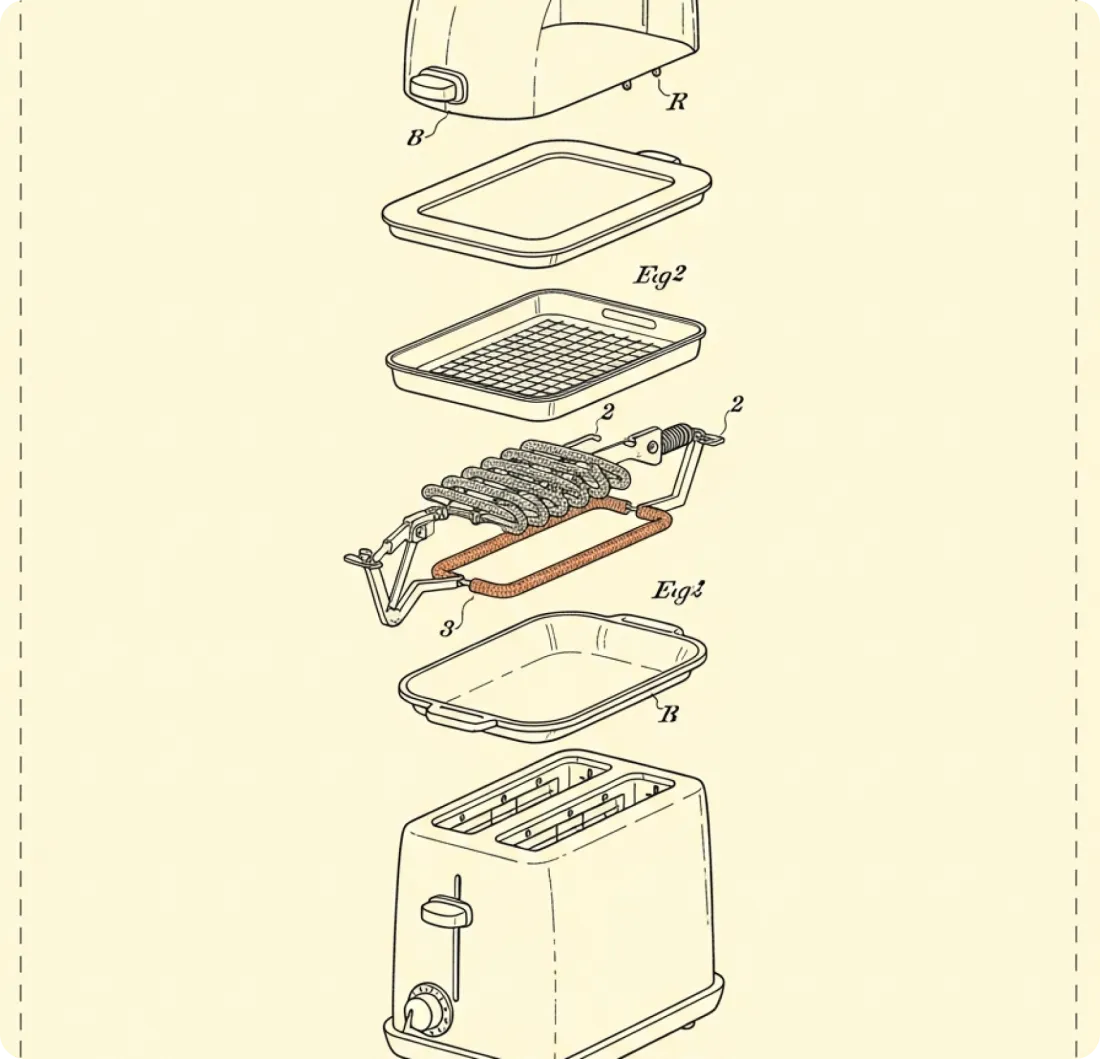
A toaster is the most ordinary object imaginable, and one capable person with nine months, a budget and access to modern information could not reproduce a four-pound version of it. Everything that makes the shop toaster possible is folded invisibly into a thing that costs less than lunch: the mining, the metallurgy, the polymer chemistry, the tooling, the supply chains, the standards, the accumulated corrections of a century of manufacture. The object conceals the civilisation that produced it.
And notice what made that visible. Not analysis. Not documentation. An attempt to rebuild it.
A finished thing carries its own making, but it does not disclose it. What it holds is far smaller than what went into it, and the difference is not recoverable by inspection; you cannot read the process off the product. You can only try to make it again, and measure where you fail. Thwaites’ nine months and £1,187.54 are that measurement, priced.
Three cases, three ways of losing what it took.
Dürer loses the evidence behind a representation. Michelangelo loses the development behind a maker. Thwaites loses the production inside an artifact: the accumulated method that an ordinary finished thing carries without disclosing. In each, the finished work outlives the conditions that made it possible, and becomes detached from something a later person would need.
This is not a historical observation. It is the ordinary condition of professional work.
A finished report does not carry the alternatives that were considered and rejected. A shipped system does not carry the reasoning that chose its architecture, or the failures that ruled out the other three. A trained colleague who leaves does not leave behind the judgment that made them worth trusting. And because an expert makes difficult work look obvious, the steps that formed the expertise quietly fall out of the training plans, the budgets, the schedules and the internal records, so organisations praise expertise while underinvesting in whatever produces it. In each case the artifact survives and the conditions of its making do not, and the next person inherits a conclusion they cannot examine, adapt, or safely extend.
So the belief underneath all of this is simple: other people should receive more than our conclusions. They should be able to examine the evidence, the reasoning, the context, the alternatives, the uncertainty, the failures, the revisions, the relationships and the judgment through which an outcome became possible. They should be able to see where something came from, what changed it, who had authority over it, where it remains incomplete, and why anyone chose to rely on it.
And an equally important refusal: none of that is the same as truth, and none of it automatically transfers understanding. A complete record can still be wrong. An accessible record can still fail to make anyone capable. A preserved record does not grant permission for every later use. Those are three separate things, and confusing them is how well-intentioned systems do harm.

Which makes the governing question not how do we store knowledge? but:
How can people carry understanding forward without confusing the record with truth, access with capability, or preservation with permission?
That question is where the work begins. What follows from it is a longer conversation than this one: the mechanisms, the products, the arguments about how to build any of this honestly. I’m really excited to have it with people who already recognise the problem.
Dürer’s rhinoceros. Dürer never saw the animal; a merchant’s newsletter and a sketch of uncertain authorship reached Nuremberg. British Museum, preparatory drawing (SL,5218.161); National Gallery of Art, The Rhinoceros, 1515 (accession 1964.8.697). The defensible reading is an indirect and incomplete evidence chain that hardened into authority through reproduction: not deception, and not a failure of skill.
Michelangelo’s David. Galleria dell’Accademia; Victoria and Albert Museum, “The story of Michelangelo’s David.” The block was quarried and partly worked by Agostino di Duccio, briefly attempted after him by Antonio Rossellino, and abandoned before the commission of 1501. “There is no zero-shot David” is rhetorical framing about obscured developmental lineage. It is not a literal machine-learning classification, and it is not a complete account of genius. The photograph is John Brampton Philpot’s, made around 1865 to 1870, showing the statue on its plinth outside the Palazzo Vecchio; Public Domain Mark 1.0.
The Toaster Project. Thomas Thwaites, Royal College of Art, 2009; the maker’s own account, and the book of the same name (2011). The Victoria and Albert Museum holds the installation (museum no. W.12:1-2014) and records both the £1,187.54 figure and the sourcing: Forest of Dean, the Isle of Anglesey, the west coast of Scotland. Part counts differ between accounts, from about four hundred to four hundred and four, across more than a hundred materials. On the ending, Thwaites writes: “extremely dangerous because I’d not managed to make any insulation for the wires … the element got so hot it melted itself! I had some warm(ish) bread though.”
These three cases illustrate a mechanism. They do not, by themselves, establish anything about how records ought to be built. That argument has to be made on its own terms, and this piece does not attempt it.
Revised 7 August 2026. The first version of this piece said the toaster “glowed briefly and failed.” It did not: the element melted itself about five seconds in, and produced warm bread first. The Dürer and Michelangelo sections were expanded, the sourcing was checked against the museum records linked above, and these notes were added.
