About · Matt Hanson
I turn ambiguous problems into shipped systems — and the teams that ship them.▋
Design engineer for over two decades — creative direction across studios, AR platforms at Meta scale, and consumer software shipped solo with AI. I work at the seams: between people, disciplines, technologies, and ideas.
Career · at a glance
Patents & press
Patents
- US11295503B1 — “Interactive avatars in artificial reality”
- Part of 15+ granted / filed patents across AR and AI while at Meta.
The path · newest first
From Meta until now, the shape of design and product leadership kept changing. My response was to go back to building, with AI as a coding partner.
The progression is deliberate: tools for my own ceramics hobby, then design at startups, prototypes for partners, and the work that’s followed. Each project builds on the last in complexity and quality.
Heirloom (recipe preservation, social cookbooks) is the headline now — a native iOS app with AI-assisted import across five formats, shared cookbooks with real-time sync, and push notifications. Built solo. Silly Questions (a 2-player AI art party game) shipped earlier as a smaller test of the method.
Not everything sticks: Zero shipped cross-platform to the App Store and I deprioritized it — the trust ceiling for AI in email triage was higher than the build could clear, and a one-person studio couldn’t carry the third-party-dependency surface required to close the gap. Shipping it, then judging it honestly, was the point.
The bet: consumer software a single builder can credibly own end-to-end.
I joined Meta in 2017 as an Art Director on Messenger AR. In early 2018 the AR product team recruited me, and the role shifted from creative direction to product design management.
Over five years (2018–2023, Reality Labs), a small camera-effects team grew into Spark AR — Meta’s AR platform of runtime, capabilities, and creator tooling within a 400+ person XFN organization, used by billions across Facebook, Instagram, and Messenger and extended from mobile to headsets.
The Experiences team scaled from 2 to 22 under my lead, took AR Commerce from prototype to launch across Instagram and the Family of Apps with 10+ retail partners, and introduced the Product Design Prototyper role that lifted prototype velocity 60+%.
The Orion chapter followed as Experience Lead, driving progress across multiple use cases and teams toward Orion AR Glasses Day-1 experiences, alongside Quest MR Mode.
From 2023 to 2025 the focus moved to FAIR, where I led 4+ teams on the Embodied AI program — strategy and prototyping for AI agents across glasses, headsets, and robotics, including SIRo (socially intelligent robots) and Motivo (behavioral foundation models). My teams across these chapters contributed to 15+ patents in AR/AI.
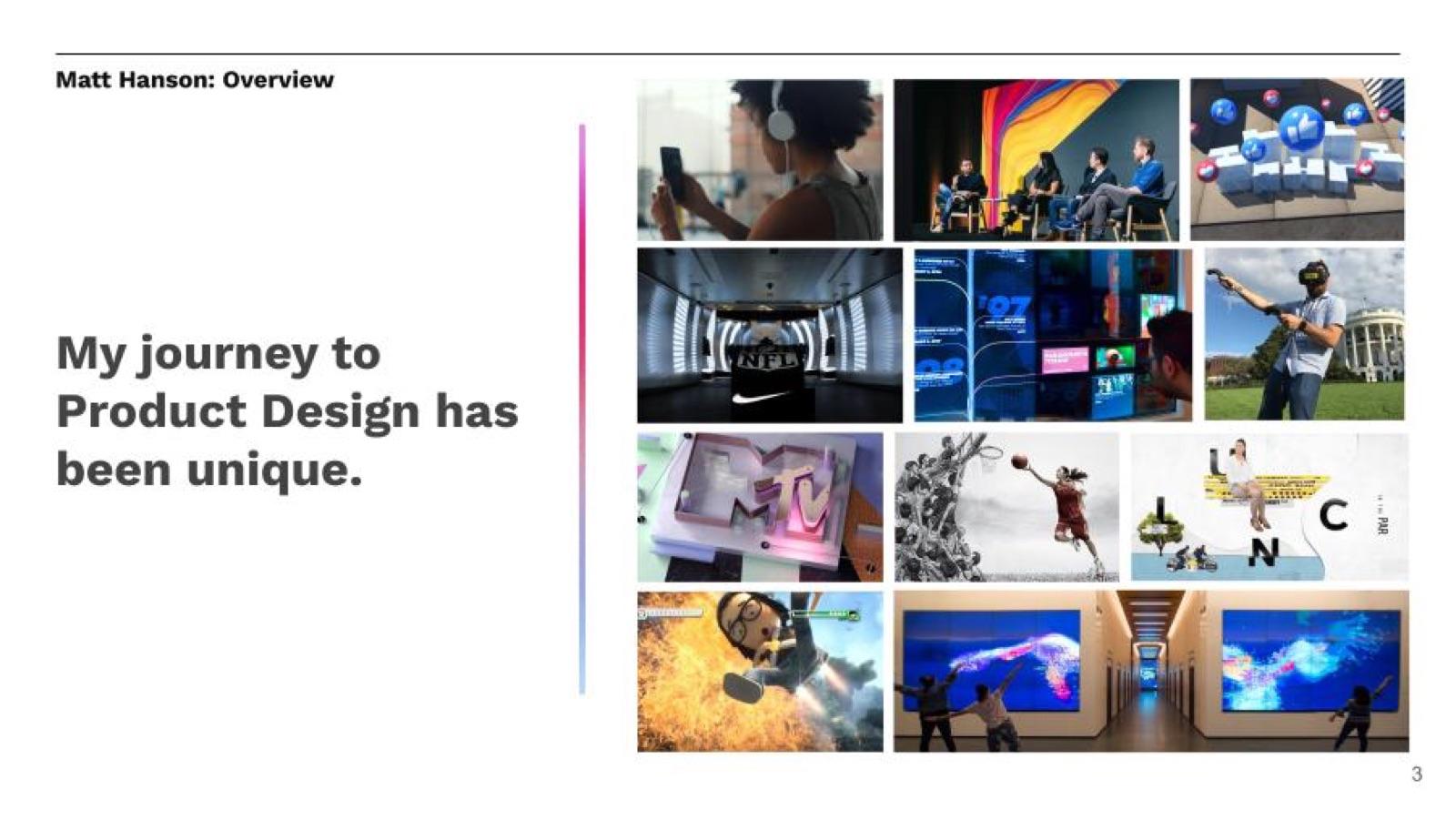
Before Meta: mixed-reality installations at Viacom — the Past Present and Future room, Outrage Machine on Times Square, the MTV Open Your Eyes Tilt Brush show at the White House — then a Framestore VR studio.
It followed creative direction and visual effects at Psyop, Imaginary Forces, Buck, and my own studio, until AR took over.
The through-line · 3D content, three eras
3D content on screens. Broadcast, film, and motion for MTV, the NFL, and beyond.
3D content on screens atop the real world. Mixed-reality installations and interactive rooms.
3D content as a persistent digital layer atop the real world. AR platforms and glasses.
How I work · the credo
Self-expectations
- I will always care deeply about the well-being of our people and the results we’re accountable for.
- I will always align on direction before accelerating.
- I will always champion the success of others, and build resilience when helping people grow.
- I will always lead with transparency, and speak with candor.
- I will probably apologize too much, sorry.
Team-expectations
- We will establish a culture of care.
- We will influence through sound thinking and strong execution to drive results.
- We will strive for simple, elegant solutions.
- We will establish shared goals and mutual understanding as the cornerstone of cross-functional collaboration.
- We will drive a thoughtful understanding of our users by validating or invalidating our hypotheses.
Reach
Available for very selective partnership work.
I write about the method at rationaledesign.substack.com. If you’re building something where vision has to survive contact with reality, start a conversation.
The work
Nine chapters, newest first.